
Dedicated Service Medals for 10 years, 20 years and National Order of Merit Silver
I am a very simple nature conservationist with a very simple interest on herpetology beyond my ritualistic forest, wildlife, wetland, culture and nature conservation works which I have no less interest in. As such, I do record all species of amphibians and reptiles wherever I see and whenever I get time since I see no one working for this group of animals in Bhutan. But what I do is not for popularity nor is it for any other gains. I do it because I feel it important to have data on this group of animals too like mammals, birds, and host of other animals with many interested individuals working. It is just unfortunate that not many people are interested in these particular taxa as many are afraid of them including the educated lot. Even our religion forbids study of this taxon for reasons mentioned in the holy scriptures. So, I am not amazed to see only few people interested to work with me. However, whatever I do is entirely for conservation, a subject that I am very much into and international and national awards are not in my mind at all. But being awarded out of blue, I feel proud to have received it. I hope it is not for the study I do on this taxon that I have been given the NATIONAL ORDER OF MERIT AWARD (SILVER MEDAL). I fervently hope that the Medal found the correct awardee in me.
With this background, I would like to present a few of my works which I wish to keep recorded online in my blog not to show off (not at all) but for easy reference in case people (by any chance) want to know about me although I know I am not a VIP. I feel it important to keep some information about myself online too for reasons that I know myself. I have given my real identity as a person in my blog’s very few posts and that relieves me of the burden of introducing myself time and again. Therefore, I will directly go to my work beginning from the latest positions and add some additional responsibilities I have shouldered thus far. But before that, I would like to blow my own trumpet (perhaps donkey praise) by noting some works I do beyond my normal job and list them here under.
1. RSPiaN - Member of Royal Society for Protection of Nature, the country’s first NGO
2. Member of Bhutan Ecological Society (BES) since its inception in 2013
3. Member of Chiroptera Conservation and Information Network of South Asia – CCINSA
4. Member of Rodentia, Insectivora and Scandentia Conservation and Information Network of South Asia – RISCINSA
5. Member of South India based Amphibian Network of South Asia (ANSA)
6. Member of South India based South Asian Reptile Network (SARN)
7. Member of IUCN SSC Viper Specialists Group (VSG)
8. Member of IUCN SSC Amphibian Specialists Group (ASG)
9. Member of International Society of Ethno-biology (ISE)
10. Member of species naming committee and Focal Point for Amphibians and Reptile identification for Bhutan appointed through Technical Advisory Committee, Department of Forest and Park Services, Ministry of Agriculture, Bhutan.
1. RSPiaN - Member of Royal Society for Protection of Nature, the country’s first NGO
2. Member of Bhutan Ecological Society (BES) since its inception in 2013
3. Member of Chiroptera Conservation and Information Network of South Asia – CCINSA
4. Member of Rodentia, Insectivora and Scandentia Conservation and Information Network of South Asia – RISCINSA
5. Member of South India based Amphibian Network of South Asia (ANSA)
6. Member of South India based South Asian Reptile Network (SARN)
7. Member of IUCN SSC Viper Specialists Group (VSG)
8. Member of IUCN SSC Amphibian Specialists Group (ASG)
9. Member of International Society of Ethno-biology (ISE)
10. Member of species naming committee and Focal Point for Amphibians and Reptile identification for Bhutan appointed through Technical Advisory Committee, Department of Forest and Park Services, Ministry of Agriculture, Bhutan.
PROJECTS – Unofficial
1. Completed a project on the “Amphibian fauna of Punakha-Wangduephodrang Valley” with a grant of £ 6000 from Rufford Small Grant Program based in United Kingdom. Visit http://www.rufford.org/rsg/projects/jigme_tshelthrim_wangyal.
2. Pictorial guide to the amphibians and reptiles of Bhutan – An on-going project funded by Rufford Small Grant Program. This is the Second Grant (£ 6000) for the Project given to a same group/individual for continuity. Visit http://www.rufford.org/rsg/projects/jigme_tshelthrim_wangyal.
NB: There are few more but these two are relevant for conservation.
1. Completed a project on the “Amphibian fauna of Punakha-Wangduephodrang Valley” with a grant of £ 6000 from Rufford Small Grant Program based in United Kingdom. Visit http://www.rufford.org/rsg/projects/jigme_tshelthrim_wangyal.
2. Pictorial guide to the amphibians and reptiles of Bhutan – An on-going project funded by Rufford Small Grant Program. This is the Second Grant (£ 6000) for the Project given to a same group/individual for continuity. Visit http://www.rufford.org/rsg/projects/jigme_tshelthrim_wangyal.
NB: There are few more but these two are relevant for conservation.
ASSIGNMENTS – Unofficial
1. External Examiner to B Sc Life Science Program of Sherubtse College, Royal University of Bhutan since 1st October 2014 to 30th September 2017 (for a fixed term of three years from the date of appointment).
2. Reviewer, Reptile Papers for Journal of Threatened Taxa for 2013 – 2014 (http://threatenedtaxa.org/editorial_board.asp)
3. Desuung – Guardian of peace member since August 2015 for life (http://www.desuung.org.bt/)
4. Attending to queries on line through face book page https://www.facebook.com/groups/bhutanherps/
5. Blogger at http://www.guyoumtsalos.blogspot.com
6. Invited Guest Speaker for the Edinburgh University School of Biomedical Sciences’ Summer School for M Sc (Biodiversity, Wildlife and Ecosystem Health) from 3rd to 7th July 2017. University of Edinburgh, Scotland, United Kingdom.
7. Member of Editorial Board Bhutan Journal of Natural Resources and Development accessed at http://www.bjnrd.org/ run by College of Natural Resources, Lobesa.
THE STORIES
It is twenty years (my Silver Medal for completing 20 years’ service is due this year) that I have had the privilege of taking government salary for working on subjects that I am interested, and I know that any measure of thanks to the state would not suffice. Therefore, I have nothing much other than to thank the system for all they have done to me. Having worked for two decades, there are many things that I have done thus far as a common civil servant and a person working on nature conservation. So, there are no surprises in here but just some facts noteworthy.
2018
Beginning January 2018, I have been promoted to Deputy Chief Forest Officer based on the number of years I have served as Senior Forest Officer. There is nothing like free lunch and I certainly worked to keep up to the expectations of the system. There are many official works that I did to deserve this promotion. So, for promoting me well in time, I would like to thank the system. You work, you are rewarded.
2017
I served as an External Examiner for B Sc Life Science Programme for Sherubtse College, Kanglung (https://www.sherubtse.edu.bt/), Royal University of Bhutan for three consecutive academic sessions from 2014 to 2017 (Figure 1). For giving me such an opportunity and privilege, I thank the College authorities and Royal University of Bhutan system. I just hope I have done justice although I could not visit more than once. This was a new experience. You work, you are rewarded.
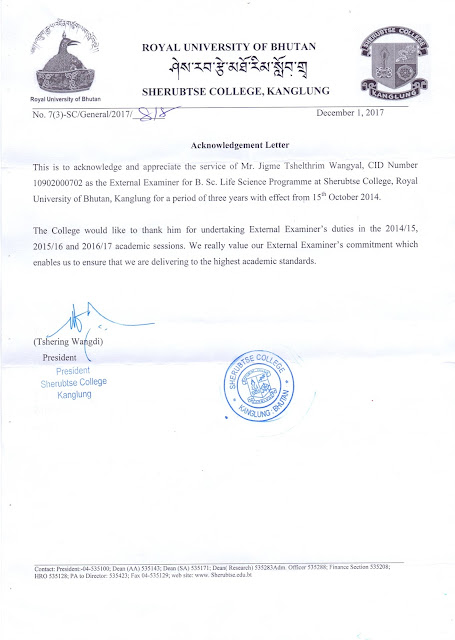
1. External Examiner to B Sc Life Science Program of Sherubtse College, Royal University of Bhutan since 1st October 2014 to 30th September 2017 (for a fixed term of three years from the date of appointment).
2. Reviewer, Reptile Papers for Journal of Threatened Taxa for 2013 – 2014 (http://threatenedtaxa.org/editorial_board.asp)
3. Desuung – Guardian of peace member since August 2015 for life (http://www.desuung.org.bt/)
4. Attending to queries on line through face book page https://www.facebook.com/groups/bhutanherps/
5. Blogger at http://www.guyoumtsalos.blogspot.com
6. Invited Guest Speaker for the Edinburgh University School of Biomedical Sciences’ Summer School for M Sc (Biodiversity, Wildlife and Ecosystem Health) from 3rd to 7th July 2017. University of Edinburgh, Scotland, United Kingdom.
7. Member of Editorial Board Bhutan Journal of Natural Resources and Development accessed at http://www.bjnrd.org/ run by College of Natural Resources, Lobesa.
THE STORIES
It is twenty years (my Silver Medal for completing 20 years’ service is due this year) that I have had the privilege of taking government salary for working on subjects that I am interested, and I know that any measure of thanks to the state would not suffice. Therefore, I have nothing much other than to thank the system for all they have done to me. Having worked for two decades, there are many things that I have done thus far as a common civil servant and a person working on nature conservation. So, there are no surprises in here but just some facts noteworthy.
2018
Beginning January 2018, I have been promoted to Deputy Chief Forest Officer based on the number of years I have served as Senior Forest Officer. There is nothing like free lunch and I certainly worked to keep up to the expectations of the system. There are many official works that I did to deserve this promotion. So, for promoting me well in time, I would like to thank the system. You work, you are rewarded.
2017
I served as an External Examiner for B Sc Life Science Programme for Sherubtse College, Kanglung (https://www.sherubtse.edu.bt/), Royal University of Bhutan for three consecutive academic sessions from 2014 to 2017 (Figure 1). For giving me such an opportunity and privilege, I thank the College authorities and Royal University of Bhutan system. I just hope I have done justice although I could not visit more than once. This was a new experience. You work, you are rewarded.
Figure 1: External Examiner-ship: Well outside my job description!
Moved to Jigme Khesar Strict Nature Reserve (JKSNR), Haa on transfer. I represented JKSNR on my own interest and presented a paper at the Bhutan Ecological Society (BES) Annual Symposium and the organizer appreciated my job (Figure 1a) on the status of snow leopard at the Jigme Khesar Strict Nature Reserve. People applauded, Kuensel made headline of our paper “Snow Leopards no more Endangered.” I think this work also deserve some credit. Information on this subject had slept for long in the office, so I did put it out for public view. I missed the third annual symposium in 2016 for domestic reasons but attended the first and the second symposiums which is based on the spirit of volunteerism for nature conservation. You work, you are rewarded.

Figure 1a. Speaker, BES Annual Symposium 2017 - Extra effort but well within my TOR.
2016
Before I left the District Administration (http://www.trashigang.gov.bt/) following the merger of District Forest Office to nearby Territorial Divisions and Protected Areas, Dasho Dzongdag (The Governor) was kind enough to recognize my contribution to the District System through an appreciation note (Figure 2). I thank the District Administration and its Leader for such encouraging statement about me. You work, you are rewarded.

I completed my Master of Science Degree in BWEH (Biodiversity, Wildlife and Ecosystem Health) (Figure 3) from the University of Edinburgh, Scotland, UK (https://www.ed.ac.uk/). While I depended on the country’s funds for my studies until I completed my Bachelors, I secured funds for my M Sc myself from the University itself. I consider enhancing my qualification without having to depend on my country’s resources as my contribution. Yes, I think of it as a contribution. You can get qualified yourself if you work hard. You work, you are rewarded.

I attended Guardian of Peace Course (http://www.desuung.org.bt/) (Figure 4) along with a good mixture of attendees. Fortunate, I was among the few more than forty guys and had to undertake a lot of pressure with the young colleagues. This course hardened me and gave me lots of wisdom to be patient in any situation. The foul-mouthed instructors and their officers made me tolerant which boosted my moral many times when they kept us standing for long time for apparently no good reasons. I think they were checking our patience. I did develop some resilience to tough situations and I thank the state for creating such opportunities. You work, you are rewarded.

I got myself invited to the University of Wageningen, Netherlands (https://www.wur.nl/en) for an international course on Plant Gene Conservation and Use (Figure 5). I met with students from few other countries and learned how important it is to preserve plant gene for food security. I thank the NUFFIC for creating such an opportunity. You work, you are rewarded.

Me and my team implemented Gamri Watershed Management Plan by securing fund (Nu. 2.3 Crores) through UNDP GEF Small Grants through my friend who was coordinating the Small Grants Program for Bhutan. My supervisors found me very resourceful because the watershed plan that was made in 2009 was revived by sourcing in the fund. For this and many other work that I did outside my mandatory plans and programs, my supervisors and leaders gifted me with meritorious promotion (Figure 6) making me a proud champion. Being a simple person, I know what does meritorious promotion mean to me. You work, you are rewarded.

Me and my team formed many community forest management groups but that was our duty. But I tell you, in the Dzong, work is multitasking. I can't list what all I did, but I did a lot. It is the Dzong from where many public services are delivered and I feel lucky to have served the Dzong system. Many thanks to my leaders in the Dzong I served, they treated me well and I did my best. They found me so good and gave me good grade. For doing my work with diligence they gifted me with praises and facilities. They recommended me to take a course on Good Governance and Rural Development at NIRD (http://www.nird.org.in/), India (Figure 7) and I completed it with dignity. You work, you are rewarded.

Figure 2: Appreciation Letter from Dzongdag - certainly encouraging.
Figure 3: My Second Degree - Obtained through perseverance and hard work.
2015 I attended Guardian of Peace Course (http://www.desuung.org.bt/) (Figure 4) along with a good mixture of attendees. Fortunate, I was among the few more than forty guys and had to undertake a lot of pressure with the young colleagues. This course hardened me and gave me lots of wisdom to be patient in any situation. The foul-mouthed instructors and their officers made me tolerant which boosted my moral many times when they kept us standing for long time for apparently no good reasons. I think they were checking our patience. I did develop some resilience to tough situations and I thank the state for creating such opportunities. You work, you are rewarded.
Figure 4: Certified Desuup - A peace keeper for all time.
I got myself invited to the University of Wageningen, Netherlands (https://www.wur.nl/en) for an international course on Plant Gene Conservation and Use (Figure 5). I met with students from few other countries and learned how important it is to preserve plant gene for food security. I thank the NUFFIC for creating such an opportunity. You work, you are rewarded.
Figure 5: Genetic Resources Conservation - Important for survival of mankind.
2014 Me and my team implemented Gamri Watershed Management Plan by securing fund (Nu. 2.3 Crores) through UNDP GEF Small Grants through my friend who was coordinating the Small Grants Program for Bhutan. My supervisors found me very resourceful because the watershed plan that was made in 2009 was revived by sourcing in the fund. For this and many other work that I did outside my mandatory plans and programs, my supervisors and leaders gifted me with meritorious promotion (Figure 6) making me a proud champion. Being a simple person, I know what does meritorious promotion mean to me. You work, you are rewarded.
Figure 6: Meritorious Promotion - Being resourceful and working outside TOR
2013 Me and my team formed many community forest management groups but that was our duty. But I tell you, in the Dzong, work is multitasking. I can't list what all I did, but I did a lot. It is the Dzong from where many public services are delivered and I feel lucky to have served the Dzong system. Many thanks to my leaders in the Dzong I served, they treated me well and I did my best. They found me so good and gave me good grade. For doing my work with diligence they gifted me with praises and facilities. They recommended me to take a course on Good Governance and Rural Development at NIRD (http://www.nird.org.in/), India (Figure 7) and I completed it with dignity. You work, you are rewarded.
Figure 7: Good Governance and Rural Development Course for a Forester was refreshing
2012
I joined back Bumdeling Wildlife Sanctuary only to move directly after taking relieving order for Dzongkhag Administration, Trashigang as Dzongkhag Forest Officer. I thought I was fully utilized as civil servant in the Dzong and feel satisfied to have worked there and I think I did my best as civil servant. Every day you have something important to attend to. It is also from here that I appeared for Bhutan Civil Service Examination (people say that it is the highest civil service exam) and I cleared it with good percentage. Fortunate, I could change my civil service rules classified work group supervisors to professional and management group (Figure 8). I thank the system for creating this opportunity, otherwise I could have resigned as senior supervisor. There are no serious differences between the two groups but human thinking always find it different and I am also a human being. You work, you are rewarded.

Spent whole of the year attending classes to complete my degree. This was one of the finest part of my life as I enjoyed a lot learning many things more outside the classes than inside. So, I did not keep quiet. I wrote a number of papers on herpetology and many other nature based subjects and got them published in journals. Thanks to the state. Without the study opportunity, I could have landed up as supervisor somewhere or may be I could be selling doma or clothes or groceries somewhere. Papers are valuable for conservation and my contributions are through them. While in the College, I contested for Councillor-ship considering my age and experience, but then we had someone who served the government more than 24 years in our group. So, I gave my votes to him and I settled for a House Councillor. This is not such a big contribution but all little things put together makes it big. I did my job well and the College appreciated me (Figure 9) for which I wish to thank the College (http://www.cnr.edu.bt/). You work, you are rewarded.

I entered civil service as a Forest Ranger on October 9, 1998. Unfortunate, by 2006, then civil service's Position Classification System found my qualification not good enough to cross position level P3 (recent SS2). Fortunate however, was that, the system allowed me to study Bachelors given that I pass the so-called Entrance Examination conducted by the College. I did pass the Entrance Examination with good percentage and I did finish my Bachelors by January 2012 with good rank. I thank the system for creating this opportunity, otherwise I could never have enhanced and broaden my views on many things. I obtained my Bachelors Degree with THIRD position in the class and that was recognized too (Figure 10). I wish to thank my Lecturers and friends for making this happen. You work, you are rewarded.

I joined back Bumdeling Wildlife Sanctuary only to move directly after taking relieving order for Dzongkhag Administration, Trashigang as Dzongkhag Forest Officer. I thought I was fully utilized as civil servant in the Dzong and feel satisfied to have worked there and I think I did my best as civil servant. Every day you have something important to attend to. It is also from here that I appeared for Bhutan Civil Service Examination (people say that it is the highest civil service exam) and I cleared it with good percentage. Fortunate, I could change my civil service rules classified work group supervisors to professional and management group (Figure 8). I thank the system for creating this opportunity, otherwise I could have resigned as senior supervisor. There are no serious differences between the two groups but human thinking always find it different and I am also a human being. You work, you are rewarded.
Figure 8: Order that changed my Cadre, not given to those who did not work hard.
2011 Spent whole of the year attending classes to complete my degree. This was one of the finest part of my life as I enjoyed a lot learning many things more outside the classes than inside. So, I did not keep quiet. I wrote a number of papers on herpetology and many other nature based subjects and got them published in journals. Thanks to the state. Without the study opportunity, I could have landed up as supervisor somewhere or may be I could be selling doma or clothes or groceries somewhere. Papers are valuable for conservation and my contributions are through them. While in the College, I contested for Councillor-ship considering my age and experience, but then we had someone who served the government more than 24 years in our group. So, I gave my votes to him and I settled for a House Councillor. This is not such a big contribution but all little things put together makes it big. I did my job well and the College appreciated me (Figure 9) for which I wish to thank the College (http://www.cnr.edu.bt/). You work, you are rewarded.
Figure 9: Simple but effective appreciation letter from the College authorities. Wonder.
Figure 10: Proficiency Award for Academic Excellence based on marks scored.
2010
We did further research on many natural things. Plants, fungi, animals, people and many more. We have reports on them. We ran a lot of projects, BTFEC, WWF, UNDP GEF SGP, RGoB and host of others South-south Programs for three countries, etc. Can't remember all but in that year, we had more work than other years. I wrote my first major paper “Snakes and Lizards from the Bumdeling Wildlife Sanctuary Region of Bhutan: Review of Herpetofaunal Information and New Country Records” in Herp Review an American Journal run by SSAR (Society for Study of Amphibians and Reptiles) (Figure 11). I started my B Sc degree at the College of Natural Resources, Lobesa, Royal University of Bhutan. Writing paper and getting College admission by passing entrance examination require hard work. Renewed energy to study by passing all sorts of examinations mean that you worked hard. You work, you are rewarded.

Figure 11: First paper on herpetology by a single Bhutanese author - Considered unique.
2009
We rediscovered Bhutan Swallow Tail from its natural habitat officially. As I write in my blog, we marked trees in the habitat. But made it official and publish the first information about it in the national newspaper, Kuensel. Our foresters have been exceptional. Being a member of the same team, I am glad I am also a part of it by default. It is a National Butterfly now (Figure 12). Isn’t this a worthy contribution to conservation? Yes, this is. You work, you are rewarded.

Monotony gaining momentum due to ritualistic activities (marking, patrolling, biodiversity survey, socio-economic survey, timber monitoring, etc.) and feeling it important not to keep it growing (I mean monotony) we embarked on a new research field in Bhutan the “Study of Reptiles” in Bumdeling Wildlife Sanctuary with funds from BTFEC. We will not go into the details, but we did write a comprehensive report about the study (Figure 13). This study was first of its kind in Bhutan by a Bhutanese team. Our report emerged as one of the most demanded report outside Bhutan (though we never shared it) since Bhutan lacked information on this taxa. We showed the way. It is now for anyone to take up and continue it further. You work, you are rewarded.

I joined back Serzhong Park Range but soon moved back to headquarters again as instructed by then Manager. I was given research responsibilities which I did the way it has to be done. The results are invisibly producing positive impact on nature conservation. I know my contributions are small but it’s pressingly impacting. Sometimes small contributions are better than bigger ones. I returned after doing Post Graduate Diploma in wildlife management in India. I came out from the Institute with honours (Figure 14) and two Medals, namely, N R Nair Memorial Silver Medal for Best Wildlife Management Plan (Image 15) and Director’s Wildlife Conservation Award Medal (Figure 16) for best Foreign Student. I thank the system for giving me this opportunity to show how worthy I was as a field forester and a conservationist. You work, you are rewarded.


We rediscovered Bhutan Swallow Tail from its natural habitat officially. As I write in my blog, we marked trees in the habitat. But made it official and publish the first information about it in the national newspaper, Kuensel. Our foresters have been exceptional. Being a member of the same team, I am glad I am also a part of it by default. It is a National Butterfly now (Figure 12). Isn’t this a worthy contribution to conservation? Yes, this is. You work, you are rewarded.

Figure 12: Bhutan Swallow Tail, our achievement
2008 Monotony gaining momentum due to ritualistic activities (marking, patrolling, biodiversity survey, socio-economic survey, timber monitoring, etc.) and feeling it important not to keep it growing (I mean monotony) we embarked on a new research field in Bhutan the “Study of Reptiles” in Bumdeling Wildlife Sanctuary with funds from BTFEC. We will not go into the details, but we did write a comprehensive report about the study (Figure 13). This study was first of its kind in Bhutan by a Bhutanese team. Our report emerged as one of the most demanded report outside Bhutan (though we never shared it) since Bhutan lacked information on this taxa. We showed the way. It is now for anyone to take up and continue it further. You work, you are rewarded.
Figure 13: First report of its kind for Bhutan by a Bhutanese Team
2007 I joined back Serzhong Park Range but soon moved back to headquarters again as instructed by then Manager. I was given research responsibilities which I did the way it has to be done. The results are invisibly producing positive impact on nature conservation. I know my contributions are small but it’s pressingly impacting. Sometimes small contributions are better than bigger ones. I returned after doing Post Graduate Diploma in wildlife management in India. I came out from the Institute with honours (Figure 14) and two Medals, namely, N R Nair Memorial Silver Medal for Best Wildlife Management Plan (Image 15) and Director’s Wildlife Conservation Award Medal (Figure 16) for best Foreign Student. I thank the system for giving me this opportunity to show how worthy I was as a field forester and a conservationist. You work, you are rewarded.
Figure 14: Honours PG Diploma given to only those students scoring more than 75 percent.
Figure 15: N. R. Nair Memorial Silver Medal honouring Nair for his bravery in conservation.
Figure 16: Best Foreign Trainee for scoring highest mark among the Foreign Students.
2006
We worked hard. We achieved a lot. We brought a lot changes. For doing a good job, I was sent for undergoing nine months PG Diploma Course in Wildlife Management at the Wildlife Institute of India. I did excel in that course and came out with honours. Yes, I have reason to believe I am good at conserving nature. Meet people who have less information on importance of nature, explain them. Meet fishermen, find out why they are fishing? If they are doing it for self consumption, tell them to take official permit. If you come across people who are carrying timber without permit, find out if they have house to stay. Give your best, you can conserve forest by doing good and being good. Sticks are just one method. Use extension wherever and whenever applicable. You work, you are rewarded.
2005
There was significant drop in number of fishermen and hunters in the Gewog. The group hunting completely stopped and that was our biggest achievement. I bought Pchems (Prayer beads) for the old hunters and told the younger ones to focus on cash earning works. That worked wonders. Some progresses are invisible but impacting. Some are visible but are not that productive. Fishermen discussed and followed the movement of my blue car if they wanted to eat fish (only to eat not to sell) because they became hesitant after our explanation. We knew many of them doing fishing but charged only when they intended to sell, otherwise if it was for home consumption, we did not give much damn. So, many of them became good and started doing less. Such was the impact. Saved hundreds of fish but we never acted above the limit. Poor people who have nothing must depend on such resources. We were harsh but to those who had vehicles to transport, money to buy vegetables and rice. We knew exactly who they were. Yes, we worked in team as an efficient Range Team then. Yes, yes, we were champions in our own way. Don’t believe me, ask the people around the villages I worked. You work, you are rewarded.
There was significant drop in number of fishermen and hunters in the Gewog. The group hunting completely stopped and that was our biggest achievement. I bought Pchems (Prayer beads) for the old hunters and told the younger ones to focus on cash earning works. That worked wonders. Some progresses are invisible but impacting. Some are visible but are not that productive. Fishermen discussed and followed the movement of my blue car if they wanted to eat fish (only to eat not to sell) because they became hesitant after our explanation. We knew many of them doing fishing but charged only when they intended to sell, otherwise if it was for home consumption, we did not give much damn. So, many of them became good and started doing less. Such was the impact. Saved hundreds of fish but we never acted above the limit. Poor people who have nothing must depend on such resources. We were harsh but to those who had vehicles to transport, money to buy vegetables and rice. We knew exactly who they were. Yes, we worked in team as an efficient Range Team then. Yes, yes, we were champions in our own way. Don’t believe me, ask the people around the villages I worked. You work, you are rewarded.
2004
Again, there was a change in the management and we received a very hot and young Manager who wanted to change things in a day. He changed everything. He ordered me to pick up Sherimung Gewog as Range. And yes, I am a pioneer here too. I did that. I never said no to any of my Bosses' orders. I judged myself but not them. I obeyed everything, I mean everything. For impossible orders I gave possible reports. Want me to reach Aja today and come back tomorrow (Aja then was 3 days walk from Yadi, no road connection beyond Mooroong Drang), yes, possible. Ask people the details of trails and collect information through villagers. Want a report, yes, write by sitting on the table at home. Such were the works we did then. If explanations don't work, we have to find an alternative and we were good at doing that. We kept our office at Yadi since we did not have road and electricity at Serzhong then. We enjoyed. We conserved nature. We stopped environmentally nonviable boulder collection on the roads between Kaphu and Yadi. Yes, we did that. Even very influential people had to bow to our hot and action packed leader. We started patrolling Singye Dzong in Lhuentse to monitor Ophiocordyceps collection by people. Yes, we are pioneers here too. We visited Singye Dzong regularly since then. We are different. Our offices are as high as 4000 metres above sea level. We made lot of contribution by stopping fishermen from illegal fishing, being vigilant on timber operators and more than that we educated the local people and made them understand why forest is important. On every occasion we made sure to talk about how important forests are for food security, water, air and shelter. We did that. And yes, we did our job. We worked hard. Reduced incidences of illegal activities were rewards for us. You work, you are rewarded.
Again, there was a change in the management and we received a very hot and young Manager who wanted to change things in a day. He changed everything. He ordered me to pick up Sherimung Gewog as Range. And yes, I am a pioneer here too. I did that. I never said no to any of my Bosses' orders. I judged myself but not them. I obeyed everything, I mean everything. For impossible orders I gave possible reports. Want me to reach Aja today and come back tomorrow (Aja then was 3 days walk from Yadi, no road connection beyond Mooroong Drang), yes, possible. Ask people the details of trails and collect information through villagers. Want a report, yes, write by sitting on the table at home. Such were the works we did then. If explanations don't work, we have to find an alternative and we were good at doing that. We kept our office at Yadi since we did not have road and electricity at Serzhong then. We enjoyed. We conserved nature. We stopped environmentally nonviable boulder collection on the roads between Kaphu and Yadi. Yes, we did that. Even very influential people had to bow to our hot and action packed leader. We started patrolling Singye Dzong in Lhuentse to monitor Ophiocordyceps collection by people. Yes, we are pioneers here too. We visited Singye Dzong regularly since then. We are different. Our offices are as high as 4000 metres above sea level. We made lot of contribution by stopping fishermen from illegal fishing, being vigilant on timber operators and more than that we educated the local people and made them understand why forest is important. On every occasion we made sure to talk about how important forests are for food security, water, air and shelter. We did that. And yes, we did our job. We worked hard. Reduced incidences of illegal activities were rewards for us. You work, you are rewarded.
2003
Due to some changes in the management, I was moved from Bumdeling Dungzam to the Sanctuary headquarters and then I was given an extra charge of Administrative Officer (Figure 17) by the then Manager. I wonder what I did not do. Yes, I did everything my Bosses told me to do. Relevancy did not matter much. I moved down and joined head office team as ordered although I knew very well that I was not trained for administration. But before I joined headquarter the then Gup of Bumdeling played his own cards and decided not to relieve me. I thought that Gewog’s decision in their GT to request the management to keep me at Bumdeling for some more time was not too good since people could assume that I connived with the public to manipulate resources management. Afraid, I asked the Gup to kindly reconsider the decision which he did but with great reluctance. Being good is not a problem but being a public favorite could lead to serious consequences (likelihood of people assuming) and adversely affect my career. But my conscience tells me that I was human for the innocent and ignorant people because of which they liked me. Yes, I curbed unlawful activities inside our forests by using public relations than showing lawful sticks. I did my things the way people liked then and their full cooperation was the reward we got. You work, you are rewarded.

Border patrolling got intensive and frequency of visits to Pemaling, Ugyenling and Shingphel areas at the Sino-Bhutan border became regular. That’s the normal duty. A lot of activities with only three of us working in the Range Office (that was going to crack and collapse any day) at Dungzam, Bumdeling. We achieved a lot. Interesting, the butterfly that we shitted on became National Butterfly. Thumps up to the Butterfly. We walked along the trails walked by George Sheriff and Frank Ludlow unrecorded number of times. In the same year, we also established Khoma Park Range at Lhuentse. That I was involved in creating it by carving it out of Mongar Forest Division, I consider myself as a pioneer once more. Yes, I am a pioneer. I was told to run the office using the Bumdeling experience, but I did not like the idea. So, we had one of our colleagues picking up the job.
Due to some changes in the management, I was moved from Bumdeling Dungzam to the Sanctuary headquarters and then I was given an extra charge of Administrative Officer (Figure 17) by the then Manager. I wonder what I did not do. Yes, I did everything my Bosses told me to do. Relevancy did not matter much. I moved down and joined head office team as ordered although I knew very well that I was not trained for administration. But before I joined headquarter the then Gup of Bumdeling played his own cards and decided not to relieve me. I thought that Gewog’s decision in their GT to request the management to keep me at Bumdeling for some more time was not too good since people could assume that I connived with the public to manipulate resources management. Afraid, I asked the Gup to kindly reconsider the decision which he did but with great reluctance. Being good is not a problem but being a public favorite could lead to serious consequences (likelihood of people assuming) and adversely affect my career. But my conscience tells me that I was human for the innocent and ignorant people because of which they liked me. Yes, I curbed unlawful activities inside our forests by using public relations than showing lawful sticks. I did my things the way people liked then and their full cooperation was the reward we got. You work, you are rewarded.
Figure 17: Administrative Officer of the Sanctuary
2002 Border patrolling got intensive and frequency of visits to Pemaling, Ugyenling and Shingphel areas at the Sino-Bhutan border became regular. That’s the normal duty. A lot of activities with only three of us working in the Range Office (that was going to crack and collapse any day) at Dungzam, Bumdeling. We achieved a lot. Interesting, the butterfly that we shitted on became National Butterfly. Thumps up to the Butterfly. We walked along the trails walked by George Sheriff and Frank Ludlow unrecorded number of times. In the same year, we also established Khoma Park Range at Lhuentse. That I was involved in creating it by carving it out of Mongar Forest Division, I consider myself as a pioneer once more. Yes, I am a pioneer. I was told to run the office using the Bumdeling experience, but I did not like the idea. So, we had one of our colleagues picking up the job.
For my dedicated service, the Department sent me for a certificate course (Figure 18) in Wildlife Management at the Wildlife Institute of India. I am so thankful to the Department and my thanks continues. But an agonizing thing was a Deputy Forest Ranger doing PG Diploma (Wildlife Management) at the same Institute while me and my friend a full Forest Ranger trained at the actual Rangers’ College in India was doing Certificate Course. But I guess I was doing the right course and not jumping my course. Life will carry you anywhere, but you must believe in yourself. And yes, I am a Forest Ranger who has nothing to regret but rejoice. I spent more off time in office than at my home. Believe it or not. I know the truth and I am okay with truth. So, I get rewarded naturally. You work, you are rewarded.

Range activities were carried out as required. Patrolling became routine and many people became cautious about whom they addressed “Ranger Jigme." Even today, they call me by the same name. But I must confess that I was good to the public, because I found many of them innocent and they knew less about forest rules and regulations. They just knew that forest staff will impose fine on them if they cut trees. Very simple. So, I started educating them by explaining them everything I knew the moment I got opportunities. Don’t believe me. Ask the people, they will tell you. We have so many cases settled, and so many kept away from records. Since that was my normal duty, I don’t want to mention here much. I vividly remember walking through the Rhododendron scrubs with three poachers (two nationals and one Indian) involved for poaching Musk Deer to a land no one but the poachers have traveled. The blaze marks on the branches of Rhododendron shrubs were the signs through which we were led by the poachers to locate the Musk Deer traps. I know the places that I will not name here. Public of Bumdeling cooperated and helped us by carrying our rations and we could dismantle a lot of traps. Squeezing through the Rhododendrons, we rescued a pregnant Musk Deer on the third day of our tiring journey. It was hanging by its right leg on the trap so designed by poachers. The animal panicked but being with us for a while when we were freeing her off the ropes she was trapped was the best option for her (Figure 19). We released the animal. Hope it reproduced and the gene continues. The poachers design such traps so that the animals do not get rotten until they return after weeks of trapping (as informed by the poacher). I think the poachers also use sustainable concept. May be. We sent the poachers to Loongzor Jail through the Court of Law and one of them charged me at my home after a year when they were released by knocking at my door at night with Pata. But I think I was smarter than him. You know what I did to him. Yes, I was one such Forest Ranger who spent more time with the local people of my area than any one. They knew me very well and that sometimes emerged as threats. Our reward this time, animal live saved, poachers given lesson and we saw areas others haven't seen at all. You work, you are rewarded.

Figure 18: A certified Wildlifer
2001 Range activities were carried out as required. Patrolling became routine and many people became cautious about whom they addressed “Ranger Jigme." Even today, they call me by the same name. But I must confess that I was good to the public, because I found many of them innocent and they knew less about forest rules and regulations. They just knew that forest staff will impose fine on them if they cut trees. Very simple. So, I started educating them by explaining them everything I knew the moment I got opportunities. Don’t believe me. Ask the people, they will tell you. We have so many cases settled, and so many kept away from records. Since that was my normal duty, I don’t want to mention here much. I vividly remember walking through the Rhododendron scrubs with three poachers (two nationals and one Indian) involved for poaching Musk Deer to a land no one but the poachers have traveled. The blaze marks on the branches of Rhododendron shrubs were the signs through which we were led by the poachers to locate the Musk Deer traps. I know the places that I will not name here. Public of Bumdeling cooperated and helped us by carrying our rations and we could dismantle a lot of traps. Squeezing through the Rhododendrons, we rescued a pregnant Musk Deer on the third day of our tiring journey. It was hanging by its right leg on the trap so designed by poachers. The animal panicked but being with us for a while when we were freeing her off the ropes she was trapped was the best option for her (Figure 19). We released the animal. Hope it reproduced and the gene continues. The poachers design such traps so that the animals do not get rotten until they return after weeks of trapping (as informed by the poacher). I think the poachers also use sustainable concept. May be. We sent the poachers to Loongzor Jail through the Court of Law and one of them charged me at my home after a year when they were released by knocking at my door at night with Pata. But I think I was smarter than him. You know what I did to him. Yes, I was one such Forest Ranger who spent more time with the local people of my area than any one. They knew me very well and that sometimes emerged as threats. Our reward this time, animal live saved, poachers given lesson and we saw areas others haven't seen at all. You work, you are rewarded.
Figure 19: Musk Doe from Phothoenbula. Dorji RBP, holding the animal just before release.
2000
Created Bumdeling Park Range and got myself appointed as first Bumdeling Park Ranger by requesting then Park Manager to seek departmental approval to take over the area. I thought BWS then had no much work, so on my own initiative, the Park Range was created. FIRST Ranger of Bumdeling Park Range. Yes, a pioneer in Bumdeling. Looking back at my early career days, I held my head high. Wanted to work, so I created my own space. You work, you are rewarded.
1999
Moved from FRDS, Khaling Camp to Bumdeling Wildlife Sanctuary, Trashiyangtse. New sanctuary office. Involved in different kinds of surveys (biodiversity, socio-economic, etc.) although no significant works were available in the office since the management was then quite new. Not many months after joining I was instructed by my manager to accompany patrolling with RBA alone since other staff (though none of them were not my seniors at all) thought I should go being a fresher in the office. I never said no to my Manager. So, I went with armies who did not walk but galloped. I learned many things and saw many new areas. For an explorer, such chances are bigger than anything else. Perhaps more than visiting US (exaggerating). My Manager, a highly qualified person with very broad outlook was a very simple person and anyone could politely deny his instructions but I never said no to his orders. I went myself with 18 army personnel. I enjoyed the hardship. This time's reward was knowing the people of the area and getting acquainted to them. Of course the Officer In Charge of the troupe and I even enjoyed haha. You work, you are rewarded.
1998
Entered Civil Service as Forest Ranger. Got first placed at Forest Resources Management Division, then Forest Resources Development Section, Thimphu. Worked at Hurumpang Inventory Camp, Mongar, Shaliyang Camp, Pema Gatshel and Khaling Camp, Trashigang.
Noto Bene
Yes, I was then a Braggadocios Ranger and now a bragging Forest Biologist. I just put a few of my accomplishments, those I felt are outside my job description. Otherwise, I have few more things. I have a good number of papers on herpetology, batrachology and a few others on nature conservation. If anyone is interested, I can share them free of cost. For more about me, read my other posts.
Created Bumdeling Park Range and got myself appointed as first Bumdeling Park Ranger by requesting then Park Manager to seek departmental approval to take over the area. I thought BWS then had no much work, so on my own initiative, the Park Range was created. FIRST Ranger of Bumdeling Park Range. Yes, a pioneer in Bumdeling. Looking back at my early career days, I held my head high. Wanted to work, so I created my own space. You work, you are rewarded.
1999
Moved from FRDS, Khaling Camp to Bumdeling Wildlife Sanctuary, Trashiyangtse. New sanctuary office. Involved in different kinds of surveys (biodiversity, socio-economic, etc.) although no significant works were available in the office since the management was then quite new. Not many months after joining I was instructed by my manager to accompany patrolling with RBA alone since other staff (though none of them were not my seniors at all) thought I should go being a fresher in the office. I never said no to my Manager. So, I went with armies who did not walk but galloped. I learned many things and saw many new areas. For an explorer, such chances are bigger than anything else. Perhaps more than visiting US (exaggerating). My Manager, a highly qualified person with very broad outlook was a very simple person and anyone could politely deny his instructions but I never said no to his orders. I went myself with 18 army personnel. I enjoyed the hardship. This time's reward was knowing the people of the area and getting acquainted to them. Of course the Officer In Charge of the troupe and I even enjoyed haha. You work, you are rewarded.
1998
Entered Civil Service as Forest Ranger. Got first placed at Forest Resources Management Division, then Forest Resources Development Section, Thimphu. Worked at Hurumpang Inventory Camp, Mongar, Shaliyang Camp, Pema Gatshel and Khaling Camp, Trashigang.
Noto Bene
Yes, I was then a Braggadocios Ranger and now a bragging Forest Biologist. I just put a few of my accomplishments, those I felt are outside my job description. Otherwise, I have few more things. I have a good number of papers on herpetology, batrachology and a few others on nature conservation. If anyone is interested, I can share them free of cost. For more about me, read my other posts.
Disclaimer
This
is my personal thought and anything written here is not intended to
harm or promote people or things mentioned here. No one is authorized to
use the content of this blog for either official, personal or legal
purposes. People mentioned here in are fictitious characters and any
resemblance to anyone with some characters or more are purely
coincidence.


.png)


